

快播视频 researchers have discovered a way to make Lithium-powered batteries more environmentally friendly while retaining performance, stability and storage capacity.
Lithium-ion batteries use toxic, heavy metals which can impact the environment when they are extracted from the ground and are difficult to dispose of safely. Cobalt is one of those heavy metals, used in battery electrodes. Part of the problem is that lithium and cobalt are not abundantly available, and supplies are dwindling.
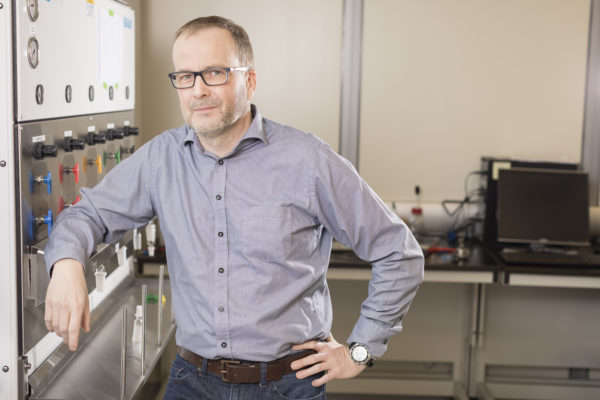
Professor Thomas Baumgartner in his lab at 快播视频
Using organic materials are the way forward and that has scientists like Professor Thomas Baumgartner of the Faculty of Science and his team busy developing and testing new molecules to find the right ones to replace the rare metals currently in use.
鈥淥rganic electrode materials are considered to be extremely promising materials for sustainable batteries with high power capabilities,鈥� he says.
Their latest breakthrough is the creation of a new carbon-based organic molecule that can replace the cobalt now used in cathodes or positive electrodes in lithium-ion batteries. The new material addresses the shortcomings of the inorganic material while maintaining performance.
鈥淓lectrodes made with organic materials can make large鈥恠cale manufacturing, recycling or disposing of these elements more environmentally friendly,鈥� says Baumgartner. 鈥淭he goal is to create sustainable batteries that are stable and have equally as good if not better capacity.鈥�
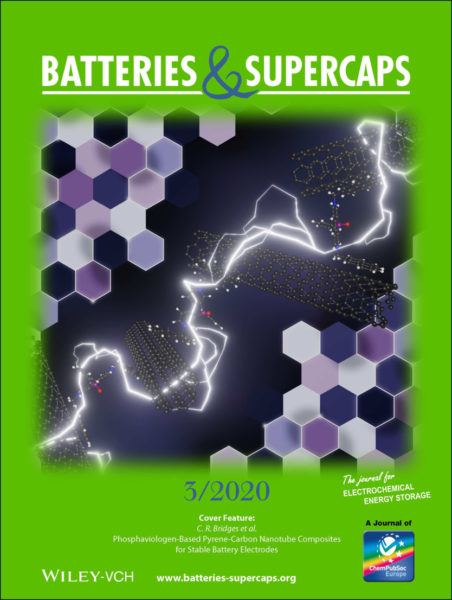
The is published and of the March edition of the journal Batteries & Supercaps, a ChemPubSoc publication.
 鈥淲ith this particular class of molecules that we've made, the electroactive component is very suitable for batteries as it鈥檚 very good at storing electrical charges and has good long-term stability,鈥� he says.
Baumgartner and his group previously reported on the electroactive component in a published in the journal Advanced Energy Materials.
鈥淲e have optimized this electroactive component and put it in a battery. It has a very good voltage, up to the 3.5 volts, which is really where current batteries are now,鈥� he says. 鈥淚t鈥檚 an important step forward in making fully organic and sustainable batteries.鈥�
Baumgartner, along with postdoctoral researchers Colin Brides and Monika Stolar, have also demonstrated that this material is stable in long-term operation with the ability to charge and discharge for 500 cycles. One of the downsides of inorganic electrodes is that they generate significant heat when charging and require limited discharging rates for safety reasons. This new molecule addresses that shortcoming.
The next step, says Baumgartner, is to improve the capacity further. His team is currently developing the next generation of molecules that show promise in being able to increase current capacity.